About Me
I am a recent Tarleton State University graduate with a B.S. in Computer Science, a concentration in Computer Engineering, and a minor in mathematics. My background sits at the intersection of low-level software and hardware, including embedded systems, analog circuit design, and performance-critical computing.
I have spent the last 2 years contributing to an NIH-funded research project developing a computational model of the human left atrium, where I optimized simulations and built tools to translate complex data into real-world understanding with real-time interactivity. That work has strengthened my appreciation for careful design, collaboration, and building systems that are both accurate and useful.
This August I will be joining Mortenson's structured cabling group as a field engineer, where I will be focused on the design, coordination, and quality assurance of structured cabling systems for hyperscale data centers. I am committed to building reliable, high-performance infrastructure that supports AI, cloud computing, and the connected world. Looking ahead, I am pursuing professional certifications in ICT design and considering graduate study in electrical engineering to deepen my impact in this space.
Beyond engineering, I enjoy learning across many different disciplines and I always bring that curiosity and passion into everything I do.
Feel free to explore my work below or reach out to connect!
Projects
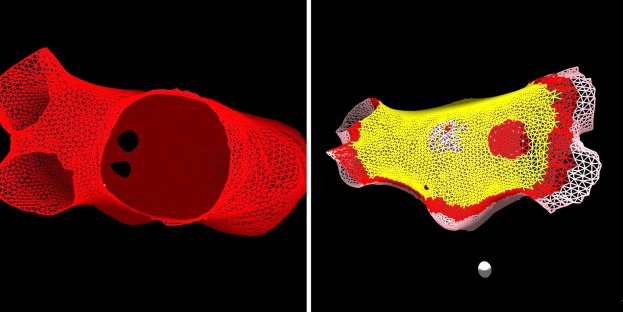
N-body Digital Twin of the Left Atrium
Project Overview: A real-time cardiac simulation that recreates the electrophysiological properties of the human left atrium. Using GPU-accelerated physics with over 13,000 interconnected nodes, the model reproduces dangerous arrhythmias like atrial flutter and micro-reentry that physicians treat with catheter ablation. Through an interactive interface, users can trigger ectopic beats, adjust tissue properties, and perform virtual ablations to test treatment strategies—creating both a procedural planning tool for cardiologists and a training platform for medical students.
My Contribution: My role evolved from optimizing CUDA kernels for computational performance to architecting and building the interactive GUI that makes this complexity accessible to medical professionals. I developed the visualization system that translates 13,000+ node interactions into intuitive real-time graphics, implemented the user controls for triggering ectopic beats and performing virtual ablations, and optimized the rendering pipeline to maintain smooth performance during intensive simulations. The result bridges the gap between computational research and practical clinical application—turning a high-performance physics simulation into a tool physicians actually want to use.
Highlights: NIH-funded research (Grant #1R15HL179671-01); NVIDIA GTC 2026 poster (PDF); 1st Place Poster — SIAM Texas/Louisiana Chapter 2024; 1st Place Undergraduate Poster — Tarleton REID Conference 2025.
N-Body Simulation of MicroPlastic-Polymer Interactions
Project Overview: A CUDA-accelerated N-body simulation modeling the interaction between microplastics and okra polymers to study microplastic removal from water. This research aimed to reduce expensive and time-consuming lab experiments by providing a computational testbed for rapidly evaluating coagulation and stirring dynamics.
My Contribution: I was directly involved in building this entire simulation from the ground up. I programmed the real-time 3D visualization using OpenGL, developed the physics engine for stirring dynamics, and worked closely with the chemistry team to translate their mathematical models into working simulation code. The coagulation algorithms were derived from chemical equations provided by the chemistry researchers, which I implemented to accurately represent how okra polymers bind with microplastics. By creating this tool, we enabled rapid iteration on experimental parameters without the need for physical lab setups, significantly accelerating the research timeline.
Highlights: 1st Place Graduate Poster – Tarleton REID Conference 2025.
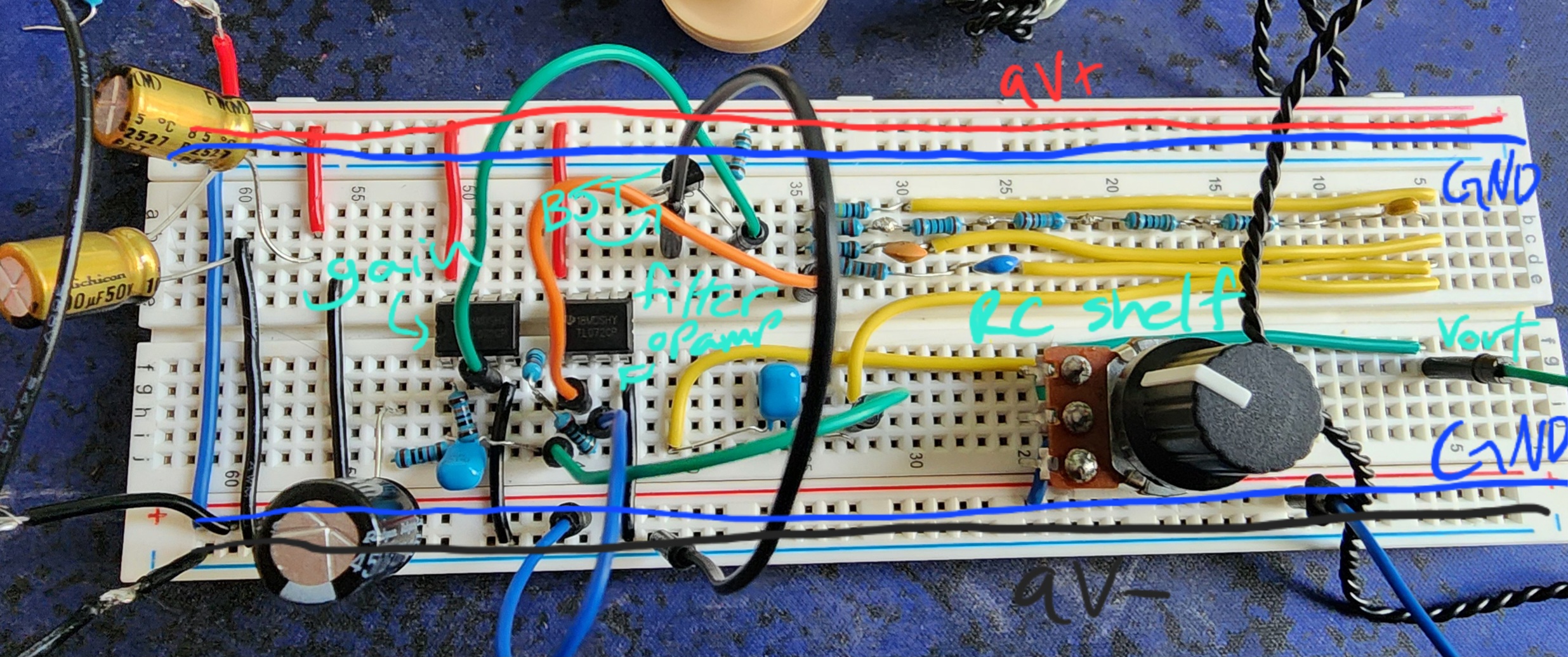
Analog Pink Noise Generator Circuit
Project Overview: An end-to-end analog pink-noise generator using a reverse-biased BC337-16 transistor for the noise source, passive RC shelves to shape the -3 dB/octave spectrum, and a TL072 gain stage with adjustable output powered by +/-9 V batteries.
My Contribution: Working with a partner, I helped design the circuit schematic from component selection through final topology. I wrote Python scripts to validate our theoretical model against expected performance characteristics and simulated the circuit in LTSpice to verify frequency response before building. I was hands-on in the physical construction, assembling the circuit on breadboard and performing bench measurements to confirm it met our design specifications. The project page includes full schematics, spectral analysis, audio samples, bill of materials, and build photos documenting the entire design process.
Publications
Near Real-Time Interactive N-body Model of the Left Atrium for Exploratory Arrhythmia Induction and Ablation Simulation
Authors: Bryant Wyatt, Leah Rogers, Mason Bane, Kyla Moore, Philip Alcorn, Gabriella Williams, Kinsey Brawner, Madhur Wyatt, Charles Puelz
Our team developed a real-time interactive N-body model of the left atrium for exploratory arrhythmia induction and ablation simulation, enabling interactive exploration and procedural planning for electrophysiological interventions.
Investigating Atrial Fibrillation Mechanisms Using an Interactive N-body Digital Twin of the Left Atrium
Authors: Leah Rogers, Kyla Moore, Mason Bane, Philip Alcorn, Gabriella Williams, Kinsey Brawner, Charles Puelz, Bryant Wyatt, Madhur Wyatt
Abstract. Our team's interactive computational model investigates mechanisms of atrial fibrillation and supports evaluation of therapeutic strategies.
Interactive Digital Twin of the Left Atrium for Simulating Atrial Arrhythmias and Virtual Catheter Ablation
Authors: Bryant Wyatt, Mason Bane, Leah Rogers, Kyla Moore, Gabriella Williams, Kinsey Brawner, Philip Alcorn, Charles Puelz, Madhur Wyatt
Abstract. Our interactive digital twin simulates atrial arrhythmias and supports virtual catheter ablation for clinical training and procedural assessment.
Studying Left Atrial Arrhythmias Using a Real-Time Interactive Digital Twin
Authors: Bryant Wyatt, Gavin McIntosh, Avery Campbell, Milanie Little, Brandon Wyatt, Mason Bane, Leah Rogers, Kyla Moore, Conner Homrighaus, Charles Puelz
Our group developed a real-time interactive digital twin of the human left atrium used to study atrial arrhythmias and to support catheter ablation planning and medical education.
"Offloading" Undergraduate Research to the Graphics Processing Unit for Acceleration
Authors: Bryant Wyatt, Mason Bane
We demonstrate methods for accelerating undergraduate research computations using GPU parallel processing (CUDA), achieving substantial performance improvements on scientific workloads. Published in the SC Workshops '25 proceedings and available in the ACM Digital Library.
Skills & Technologies
Programming Languages
Embedded Systems & Microcontrollers
Development Tools & Platforms
Design & Simulation
GPU & Parallel Computing
Education
Tarleton State University
B.S. in Computer Science (Concentration: Computer Engineering), Minor in Mathematics
Magna Cum Laude, May 2026
GPA: 3.94/4.00 (Institutional) | 3.75/4.00 (Overall) | View Degree
Relevant Coursework: Electrical Circuit Theory, Digital Systems Design, Signals & Systems, Electronics I & II, Digital VLSI, Microprocessor System Design, Data Structures & Algorithms, Computer Architecture, Operating Systems
Hill College
Associate of Arts in Liberal Arts, Aug. 2019 – Sept. 2023
Honors & Awards
Magna Cum Laude
Tarleton State University, May 2026
First Place Undergraduate Poster
Mathematical Association of America — Texas Section, Mar 2026
First Place Undergraduate & Graduate Poster
Tarleton State University REID Research Symposium, Feb 2025
President's List
Multiple Semesters — Fall 2022, Spring 2023, Fall 2023
Dean's List
Multiple Semesters — Spring 2025, Fall 2025
Credentials
B.S. Computer Science
Concentration in Computer Engineering, Minor in Mathematics | Tarleton State University, May 2026
Contact
Feel free to reach out to me:
Email: mbane0525@gmail.com
LinkedIn: linkedin.com/in/mason-bane